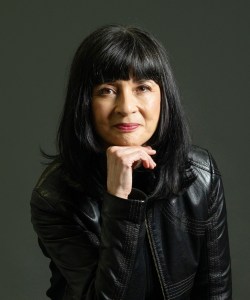
Catherine Clement is an award-winning Chinese Canadian community historian, curator and author. She is known for her extensive, crowdsourced community history projects that help uncover, share and preserve the experiences of ordinary people in extraordinary times. Her books have been extensions of her history projects. Catherine first drew acclaim for her 10-year search uncovering the hidden works of Yucho Chow, Vancouver’s first and most prolific Chinese photographer. At the end of that project, she published the award-winning book Chinatown Through a Wide Lens: The Hidden Photographs of Yucho Chow. Catherine’s latest book, The Paper Trail to the 1923 Chinese Exclusion Act, documents a monumental yet largely forgotten chapter in Canadian history. The pages of this book explore the human experience of Chinese exclusion as revealed through the stories of individuals who lived through this dark period. Despite encountering silence and a lack of community knowledge of this history when she began her research, Catherine has excavated haunting tales of tragedy, loss, despair, and powerful examples of courage, perseverance, and resilience. Many stories are being shared publicly for the first time. Based on a landmark national exhibition of collective remembrance, this book takes an unflinching look at a shameful chapter in Canada’s origin story.
Before Chinatown Through a Wide Lens: The Hidden Photographs of Yucho Chow, there was little information readily available about Yucho Chow online. What was the process like to uncover his story and work?
I started to scan the photos of Yucho Chow back in 2010 when I kept seeing his images in the albums of elderly Chinese Canadians veterans whom I was interviewing. After seeing his photos and his logo on so many photos, I wanted to know more about Yucho Chow studio. I finally googled his name and was shocked that there was basically nothing about him besides one brief notation on the website. I discovered there were no archival collections of his photos and no detailed description of the man, yet it was clear he had been a prolific photographer in his time. I realized Yucho Chow’s work was everywhere … yet nowhere. I felt he deserved to be remembered.
So I began collecting scans of his work: one photo at a time, one family at a time. And each photo shared with me had some kind of story attached, so I collected that too.
It took me five years to finally see my first photo of Yucho Chow himself, when I happened to meet one of his grandchildren. By 2019 I curated a solo exhibition of his work which included photos of many early marginalized communities: South Asians, Black Canadians, Indigenous, mixed race and eastern Europeans (e.g., Ukrainian, Polish, Croatians, etc.)
More photos came in as a result of the exhibition. And in 2020 I published the book Chinatown Through a Wide Lens: The Hidden Photographs of Yucho Chow. The following year I donated all the scanned images to the City of Vancouver Archives.
The Paper Trail to the 1923 Chinese Exclusion Act was recently published by Plumleaf Press. How did the book come to fruition from the museum exhibition?
The owner of Plumleaf Press, Maggie Goh, happened to see The Paper Trail exhibition right after it opened. Maggie knew I focussed very much on the “human experience” of the Chinese Exclusion years. And that I loved telling a big story through the small stories of real people who survived that dark period in Canada.
Months later, when I was in Toronto doing a talk, Maggie asked if I had any ideas for a book. And I replied “Yes, I certainly do.”
In the exhibition, due to space constraints in the galleries, I had to cut some material that is key to this story. As well, during the run of the exhibition at the Chinese Canadian Museum, many new stories were submitted which revealed what happened to different people in different parts of Canada. There was definitely enough material to create a book that would look at the range of experiences – from tragic to triumphant – that would show how a single law did such incredible harm.
You have had an extensive career as a curator, exhibition designer, and art director. What are the most important lessons you have learned throughout your experiences?
My work is very much about memory. And most memories are recounted as stories. But I am also a very visual person.
So I love bringing memories and stories into three dimensions – into an exhibition – where a visitor walks through a story. The visuals and the evidence of that story are all around them. And the exhibition allows us to include the stories and images of ordinary people: ordinary people living in extraordinary times.
However, the downside of exhibitions is that they are fleeting … they are temporary. And that’s where a book comes in. It is the vehicle which allows the visuals and the story to live on and to be passed on.
Another way to preserve this story is through the archival collection of early Chinese identity certificates and biographies – all collected for The Paper Trail project – which are now available online at UBC Library – Special Collections.
 LiterASIAN 2026