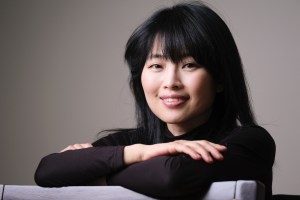
Dr. Keiko Honda is an epidemiologist, writer, and founder of the Vancouver Arts Colloquium Society. She holds a Ph.D. in Public Health from NYU and worked as a cancer epidemiologist at Columbia University. At age 40, she began using a wheelchair permanently—an experience that redirected her work toward social connection and community health. In Vancouver, she transformed her home into a cultural salon space for artists and intergenerational dialogue, work that earned her the City of Vancouver’s 2014 Remarkable Women Award and the King Charles III Coronation Medal in 2025. She teaches aesthetics of co-creation and arts-based problem-solving at SFU’s Continuing Studies. Her writing includes the memoirs Accidental Blooms (Caitlin Press, 2023) and Hidden Flowers (Heritage House, 2025), and the translation The Broken Map Home (Caitlin Press, 2025). She lives in Vancouver, where she paints in watercolour and continues her salon tradition. Born and raised in Japan, she brings a cross-cultural perspective to her work, bridging Japanese and Canadian literary traditions.
Your second memoir, Hidden Flowers, reflects on a new phase of your life and shifting identity. How did writing this memoir differ from Accidental Blooms?
Completely different, in almost every way that matters.
Accidental Blooms was written in retrospect — reflection on action, looking back at a life that had already happened and trying to understand its shape from a distance. I knew, more or less, where the story had landed. There was the comfort of hindsight, even when the events themselves had been painful. The past has edges. You can walk around it.
Hidden Flowers was written in present tense, in real time — reflection in action. I did not know the ending when I began, which is a more honest condition than it might sound, because stories never end in real life. They simply continue, and you choose a moment to stop and say: this is what I can see from here. Writing without the safety of retrospect meant living inside the uncertainty of the page at the same time as I was living inside the uncertainty of the life. There was nowhere to stand that was outside the story.
The other difference is harder to name, but it is perhaps the more important one. When I wrote Accidental Blooms, I was a mother in full force — my daughter Maya at the center of my days, her presence organizing time, attention, identity. Motherhood was the river and I was standing in it. By the time I began Hidden Flowers, Maya had left for university in Toronto. The river was the same. The water had moved on.
What I did not anticipate was how much of my sense of self had been held in place by that particular current. When she left, something I had not known was load-bearing became suddenly, vertiginously visible. I found myself at an identity threshold — not crisis, exactly, but the particular vulnerability of a person who has shed one skin and is not yet certain what grows in its place. The reader will hear that in my voice, I think. The doubt. The reaching. The willingness to sit inside a question I could not yet answer.
And so I made a decision that Accidental Blooms did not require of me: I included the parts I would have preferred to leave out.
A romance that didn’t hold. The particular dissonance that can arise inside a family when one person is changing faster than the structures around them can accommodate. The loneliness of the empty nest — which is not only the absence of a child, but the sudden, disorienting presence of a self that has been waiting, quietly, for the noise to settle.
I want to be clear: I did not include these things for drama, or to be confessional in the way that confession can sometimes substitute for honesty. I included them because they were real, and because leaving them out would have made the book a performance of adjustment rather than an account of it. The hidden flowers of the title are not only the beautiful things that bloom in unexpected places. They are also the things we keep out of sight — the struggles we manage privately, the emotions we judge ourselves for having, the evidence that we are, underneath our accomplishments and our identities, as uncertain as anyone else.
A reader who knows me well said, after finishing it: I have learned to appreciate who you really are. Wonderful to see that you have the same sensibilities, emotions and vulnerabilities which we all do.
I have been thinking about that response ever since. It would be easy to read it as a compliment about courage — the courage to be vulnerable on the page. But I think it is saying something more precise: I did not know, until now, that you were fully human. And that is not a failure of the first book. It is simply the nature of retrospect. When you write from a distance, you write from a position of having survived. The reader sees the person who made it through. Hidden Flowers is written from inside the not-yet-knowing — from the middle of the crossing, before the other shore is visible.
In some ways, it is the book Accidental Blooms was always moving toward — the moment after the arrival, when the adrenaline of becoming has quieted and you have to ask, in the silence: who am I now, and what do I do with what remains?
I did not know the answer when I began. I am not certain I know it now. But I wrote it down anyway, which is, I have come to believe, the only honest way to write a life that is still being lived.
What did your early drafts look like compared to the final version?
Content-wise, very little changed. Because I was writing in real time, documenting as I went, I was able to preserve the texture of a moment — its feeling, its specific weight — in a way that would have been impossible to retrieve later. Memory smooths things. It edits without asking permission. So I wrote in detail, deliberately, knowing I was making a record rather than a book. The feelings are the same in the early drafts. The moments are the same. What changed was almost everything else.
The early drafts were linear. Descriptive. More like field notes than literature — the what before the why, the observation before the meaning. I was a scientist again, in a way:
documenting as precisely as possible, trusting that I would understand later what I had seen. There was very little philosophy in them. Very little abstraction. Just the texture of days, set down as faithfully as I could manage.
What the editing process required was not revision so much as translation — into the form of zuihitsu: following the brush wherever attention leads, without a predetermined destination. Sei Shōnagon’s The Pillow Book is its most celebrated example — fragmentary, digressive, holding together not because of structure but because of sensibility.
Writing it is a deeply self-conscious act that wears the costume of unselfconsciousness.
That paradox took me a long time to understand. The form appears artless — unbothered by its own incompleteness. But producing that impression requires its own discipline: knowing which fragments to keep, trusting the reader enough to leave things unresolved, editing ruthlessly while preserving the feeling that nothing has been edited at all. For someone trained in the architecture of argument, the epidemiologist’s habit of knowing the hypothesis before you begin, this was not comfortable. Zuihitsu asks you to trust meaning to emerge from attention rather than imposing it — to resist arriving before you have actually traveled.
So I would start with something small — a sound, a conversation fragment, a feeling I couldn’t yet name — and follow it until it showed me where it wanted to go. Sometimes nowhere I expected. Sometimes nowhere at all. I kept those too.
The early drafts were the raw material of life. The final version is what happened when I learned to follow the brush — and discovered that the brush, given enough trust, knows where it is going even when the writer does not.
Your third memoir, Words That Last, is forthcoming Fall 2026. What can we expect from your next work?
Words That Last is the book I didn’t know the first two were preparing me to write.
Accidental Blooms asked how you survive the life you didn’t choose. Hidden Flowers asked who you are when everything that named you has shifted. This one goes underneath both. It asks what you do with what remains — and it turns out that’s an entirely different question.
I wrote it from a threshold. My daughter’s room is empty. My father’s voice thins. My mother speaks to me often, though she has been dead for six years. You either know what that sentence means or you don’t yet.
The language I needed wasn’t one I had to invent. It was waiting — written by a poet who spent his final years shedding everything he’d mastered, searching for something he called karumi: a lightness so complete it stops resisting the world and simply moves with it. Bashō found it on swollen feet, at the end of a long journey, writing about ordinary things — a frog, a crow, the sound of rain — as if they were sufficient. Because they were.
My training — scientific, Western, relentlessly forward-moving — had taught me to pass through experience rather than inhabit it. Bashō taught me to stop.
What stopped me, finally, were the things I’d been walking past: a rain chain. A teacup. My daughter’s particular silence on the phone. I had been treating them as background. They were the whole story.
The book is organized around a Japanese practice with no clean English equivalent — the art of preparing for life’s completion while remaining fully inside it. It is not what you think. It is not morbid. It is the opposite of morbid. It is what happens to attention when you stop assuming there is unlimited time.
My cat Pumpkin waits behind my wheelchair each night. Unhurried. Ungrasping. Completely there. I have been trying to learn what she already knows.
Words That Last is the record of that attempt. I won’t tell you where it ends. Only that I didn’t expect to find what I found there — and that once I did, I couldn’t unfind it.

