
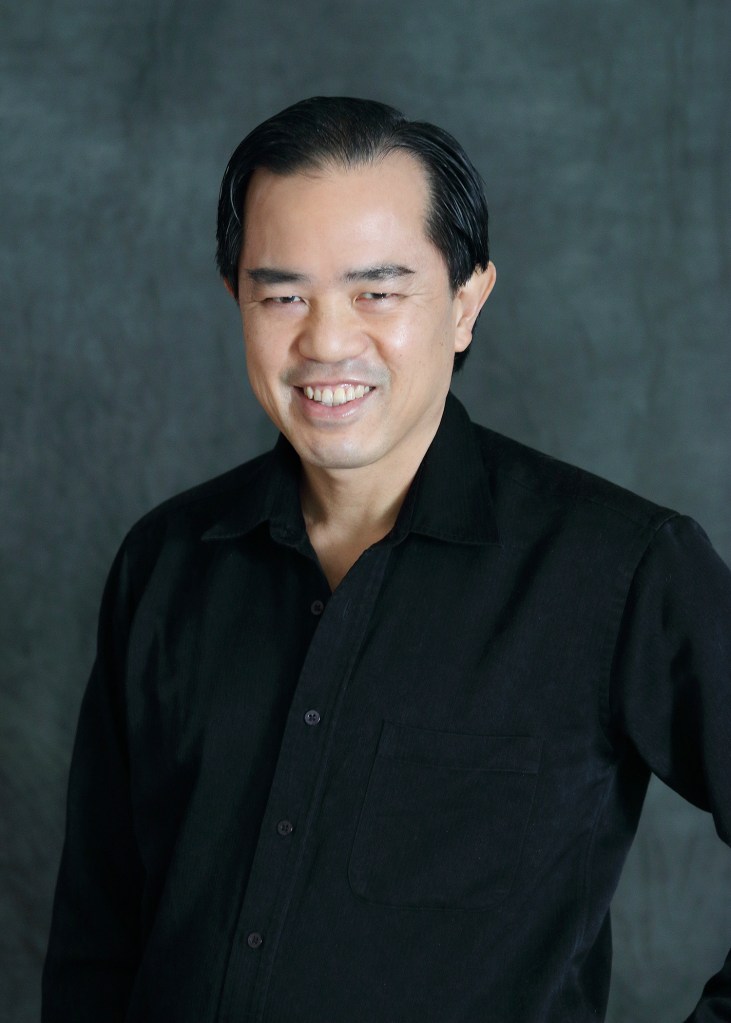
Kagan Goh is a Vancouver-based Chinese Canadian multidisciplinary artist whose work spans memoir, poetry, playwriting, filmmaking, and mental health advocacy. Diagnosed with bipolar disorder at age twenty-three in 1993, he discovered the transformative power of the written word as a path to understanding and healing. What began as self-therapy evolved into a powerful artistic voice that has made him a prominent figure in Vancouver’s spoken-word scene, where peers affectionately call him “the bipolar poet laureate.” Through spoken-word performances, theatrical work, and published writing, he delves fearlessly into themes of mental illness, recovery, and self-acceptance, advocating for the validation of all emotional experiences as essential phases of the healing journey. His mission: to raise awareness of mental health issues and dismantle the stigma surrounding mental illness. His published works include Who Let in the Sky? (Select Books, 2012), a poetic memoir exploring his relationship with his father, and Surviving Samsara (Caitlin Press, 2021), which chronicles his journey with bipolar disorder and was shortlisted for the 2022 Singapore Literature Prize in creative nonfiction. Currently, Kagan is adapting Surviving Samsara into A Delicate Imbalance, a dramatic episodic television series that continues his commitment to breaking the silence around mental illness through powerful storytelling.
You were the writer-in-residence at Historic Joy Kogawa House from November 2014 to February 2015. What was the experience like? What did you work on during that time?
My residency at the Historic Joy Kogawa House was one of the most meaningful and generative chapters of my creative life. To work within those walls — a space so intimately connected to the legacy of Japanese Canadian history and one of Canada’s most celebrated writers — was both a privilege and a profound responsibility. The house itself seemed to breathe memory. It grounded me, challenged me, and reminded me daily of why storytelling matters: to bear witness, to restore dignity, and to ensure that history is not simply forgotten.
During that time, I was immersed in developing a project called “Breaking the Silence” — the true story of Akihide John Otsuji, a Japanese Canadian man who was unjustly imprisoned for defying one of Canada’s most shameful racist policies: the Dispersal Campaign. In the aftermath of the Japanese internment, Japanese Canadians were given a brutal choice — repatriate to Japan or relocate east of the Rockies. They were explicitly forbidden from returning to their homes on the West Coast. Aki made the courageous decision to return to his hometown of Vancouver, and for that act of resistance, the Canadian government branded him a criminal.
At the heart of the story is Aki’s sister, Mary Seki, who refuses to let her brother’s name remain tarnished by history. To her, he was not a criminal — he was a hero. It takes courage to defy an unjust law, and “Breaking the Silence” is ultimately Mary’s quest to reclaim that truth: to clear her brother’s name and seek redress for the injustices that ravaged their family and community. It is a story about love, resilience, and the long arc of justice.
When I first began working on the project, I was weighing whether to adapt the story as a feature film or develop it as a novel. Both forms felt capable of honouring the scope and humanity of the material. However, as I sat with the story — and as the walls of Joy Kogawa’s house reminded me of the power of community and cultural stewardship — I came to a different and deeper conviction: that this story belongs to the Japanese Canadian community, and that Japanese Canadian artists should be the ones to tell it.
With that in mind, I began exploring the possibility of adapting “Breaking the Silence” as a stage play in collaboration with Japanese Canadian playwrights and actors — artists who could bring authentic cultural insight and lived memory to the work. A play felt right: intimate, immediate, and alive in the way live theatre can be when it confronts historical trauma head-on. I entered into early conversations with several Japanese Canadian artists to see whether they might be interested in joining the project as co-creators and stewards of this important story.
The residency gave me the time, the space, and the moral clarity to understand what this project truly needed to become. I left the Joy Kogawa House not only with pages of notes and drafts, but with a renewed sense of purpose — and a deep commitment to telling this story in a way that honours the community it belongs to.
Your debut memoir, Surviving Samsara, recounts your struggles with manic depression. What inspired you to put these experiences into words?
The honest answer is that writing saved my life before I ever thought of it as a book. I was diagnosed with bipolar disorder at twenty-three, in 1993, and in those early years of crisis and confusion, the written word became my lifeline — a way of making sense of a mind that felt like it was constantly at war with itself. For three decades, I wrote narrative poems about my lived experience with manic depression and performed them on slam poetry stages across Vancouver. It was raw, it was urgent, and it was, in every sense, self-therapy.
Over time, what began as a private act of survival became something more public and, I hoped, more purposeful. The slam poetry stage gave me a community and a voice. Peers began calling me “the bipolar poet laureate,” which I wear with both humour and pride — because it speaks to something real: that candour about mental illness, when delivered with art and craft, can crack open the silence that so many people suffering in isolation desperately need broken.
I also carry my father’s legacy. Goh Poh Seng — poet, novelist, playwright, and one of Singapore’s pioneering literary voices — taught me through his own life that literature is not decoration. It is witness. It is conscience. Growing up in his shadow, and later finding my own creative path through the wreckage of mental illness, I understood that I had a story that needed to be told — not just for myself, but for everyone who has ever felt that their suffering was too shameful, too messy, or too “mad” to speak aloud.
Surviving Samsara is the culmination of all of that: thirty years of living, writing, performing, and refusing to be silenced. My mission has always been to raise awareness of mental health issues and dismantle the stigma surrounding mental illness — to insist, unapologetically, that every emotional experience, however dark or chaotic, is a valid and essential part of the human journey toward healing.
What do you hope for readers to take away from Surviving Samsara?
Above all, I hope readers come away with empathy — a genuine, felt understanding of what it means to live inside a mind that doesn’t always obey the rules. Mental illness is still so profoundly misunderstood, so frequently reduced to caricature or catastrophe in the way it’s portrayed in popular culture. What I wanted to offer in Surviving Samsara is something rarer and more honest: an account of mental illness and recovery told from the inside, in all its complexity, contradiction, and — ultimately — its hope.
I think about the people who might pick up this book at their lowest moment — someone in the grip of a manic episode, or a family member who cannot understand why their loved one is spiralling, or a mental health worker who wants to see beyond the clinical language of diagnosis. I want every one of those readers to feel less alone. To feel seen. To understand that recovery is possible, that the darkness is not permanent, and that a full and meaningful life exists on the other side of crisis.
Stephen Gray, in his Goodreads review, described the book as potentially “a life-saver” for people who have gone through conditions similar to what I experienced, and as an “eye-opener” for those working in mental health fields. That response means the world to me, because it confirms what I always believed: that the most personal stories, told with courage and without artifice, are often the most universal.
I also hope the book challenges readers who have never experienced mental illness to expand their compassion — to resist the instinct to judge or distance themselves from those who are suffering, and instead lean toward understanding. We live in a world that still too often treats mental illness as a character flaw or a private shame. Surviving Samsara is my argument, in memoir form, that it is neither. It is a human experience — and one that deserves to be met with the same care, curiosity, and dignity we would offer any other.

