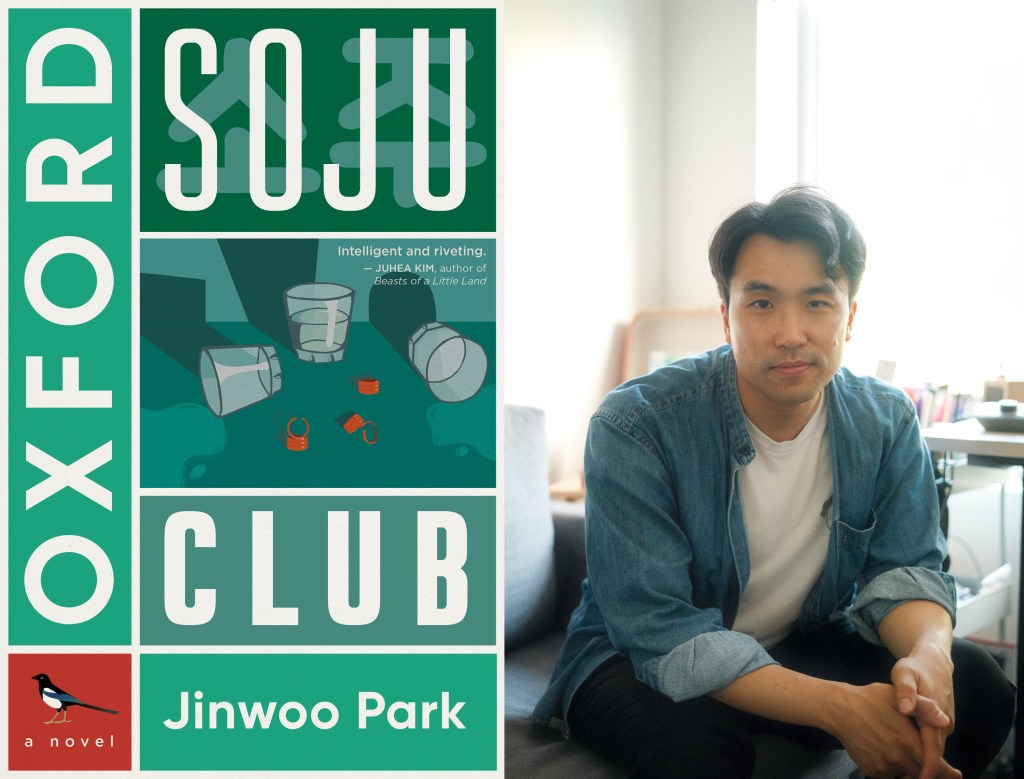
Jinwoo Park is a Korean Canadian writer based in Montreal. Born and raised in Seoul, he has lived in various parts of North America and the UK since the age of 11. He obtained his master’s in creative writing at the University of Oxford in 2015. In 2021 he won the Jim Wong-Chu Emerging Writers’ Award from the Asian Canadian Writers’ Workshop. He has also been actively working as a literary translator after winning the Emerging Translator Award from the Literature Translation Institute of Korea in late 2023. Oxford Soju Club, published by Dundurn Press, is his first novel.
Your path to publication involved social media; how did that change your relationship with writing and readers?
I wouldn’t say it changed anything regarding my writing. On the contrary, I’ve always tried to bring my own writing into my social media, which has resulted in a style of content that I feel is distinct enough to be identified as my own. However, my experience with social media did affect how I view finding a readership, which is that putting yourself out there on social media allows you to build trust with readers before they even encounter your book.
I had many people who knew me from videos that had nothing to do with the topics I explored in Oxford Soju Club go on to buy the book. It taught me that what matters most is putting yourself out there as authentically as possible, because you never really know where your readers will come from or how people will connect with you. As long as you’re out there genuinely connecting with people, readers will eventually find their way to your work.
As someone who has lived in Korea, Canada, and the UK, how did your own experiences shape the characters?
I’ve always had this sense that I was floating through the world, going from place to place, never really rooted anywhere. Every place felt temporary, and I was always looking toward the next place I’d move to. But wherever I went, I found spaces that reminded me of home. When I was a student at McGill University in Montreal, there was this place called Dokkaebi. It was the only place in the city where we could get soju. My friends and I would pile into that place almost every night, speaking Korean, spending time with other Koreans, creating this little oasis of home. That feeling was something I infused heavily into the book.
In fact, there’s a lot of me in this story. My friends would read it and say, “This is basically you,” about practically all three of the main characters. I think I knowingly, and unknowingly, fashioned each protagonist around a different side of myself that once existed: the unconditionally obedient son, the immigrant who feels ambivalent about the homeland, and the model minority. They all reflect struggles I went through as a member of the Korean diaspora.
You were the winner of the 2020 Jim Wong-Chu Emerging Writers Award for your manuscript Oxford Soju Club. What advice would you give to aspiring writers?
If you can, write for fun. My manuscript started with me simply trying to enjoy writing again. I had been in a multi-year writing slump, so I began writing whatever interested me without being concerned at all about literary merit or meaning. I wrote half of a romance novel, a collection of sci-fi stories, and a buddy-cop manuscript about North and South Korean spies, which would eventually become Oxford Soju Club.
Once I rediscovered the feeling of enjoying what I was writing, my passion for writing didn’t just return, but flourished with new energy. When I was having fun, I was writing purely for myself, working on the kind of book I would personally pick up in a bookstore. I think that’s the Goldilocks zone for a writer.

