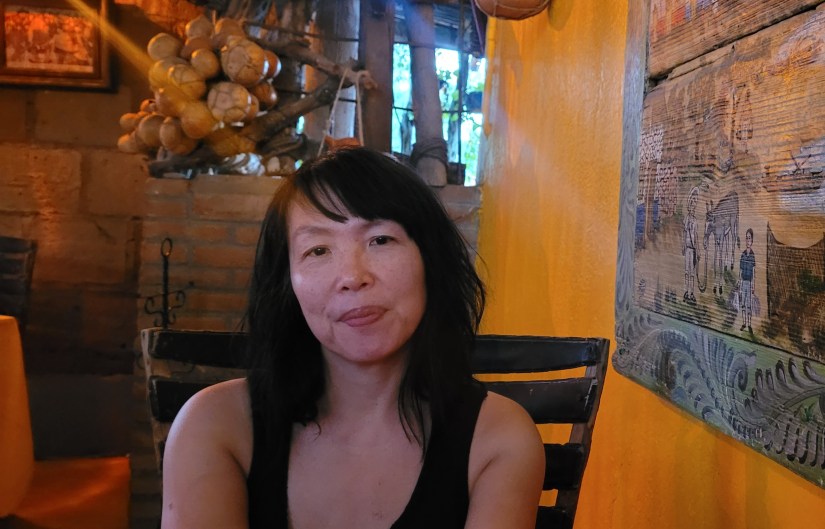
Evelyn Lau is an award-winning Canadian poet, novelist, short story writer, and memoirist based in Vancouver. She is the author of more than a dozen books, including the groundbreaking memoir Runaway: Diary of a Street Kid, published when she was just eighteen, which has become a landmark work in Canadian literature. Lau’s writing is known for its emotional precision, lyrical intensity, and unflinching honesty. Her poetry and prose explore themes of identity, survival, intimacy, urban life, and transformation, often drawing from lived experience with remarkable clarity and grace. Her work has been widely taught, translated, and recognized with numerous honours, including the Pat Lowther Memorial Award and the Milton Acorn People’s Poetry Award. From 2011 to 2014, she served as Poet Laureate of the City of Vancouver, where she championed poetry as a vital public art and mentored emerging writers.
You served as the 2011-2014 Vancouver Poet Laureate and have an extensive history in the city. How has Vancouver shaped your writing over the years?
I was born in Vancouver — 54 years ago! — and of course the city has undergone enormous changes. If you’re a writer who’s attentive to your surroundings (and writers do make a practice of paying attention, of observing), then the place you live in will inevitably insert itself into your work. Even if it isn’t deliberate, the sensory impressions of that place will form a kind of backdrop. There are so many ways of engaging with this city — culturally, politically, economically — and I’ve addressed those issues to some extent, but mostly it’s the imagery of Vancouver that has seeped into my writing. The contrast between its physical beauty and its economic disparities is something I see daily.
You are a novelist, memoirist, poet, and short story writer. How do you approach these different subjects and what are your favourite aspects of each?
It’s been decades since I’ve written prose, and it’s unlikely that I’ll return to that form. Poetry has always been my first love, but as a young writer I was also drawn to the jewel-like quality of the short story, and the emotional transparency of personal memoir. There was a certain ambition to the idea of being a “novelist”, though I always preferred the spare, atmospheric, intense quality of the novella (which was really what my “novel” was). I turned away from prose after a lawsuit was filed against an essay I wrote in my twenties; that experience definitely had a chilling effect. Poetry isn’t subject to the same scrutiny as prose; we poets complain about having few readers, but at the same time there’s safety in that reality. Poetry also suits the way my mind works: I can’t imagine writing a sprawling novel with multiple characters and plot twists, but find great satisfaction in obsessively revising a page-length poem, scrutinizing each line break and punctuation mark, reaching over and over again towards the better image.
What advice would you give to an aspiring poet?
Read poetry, of course! Starting out, I loved anthologies and literary magazines (still do) because they exposed me to a variety of voices and styles. I could “sample” so much different work, be challenged by what poetry could do and mean, and find the writers whose books I wanted to explore further.
These days, when distractions are everywhere, it’s important to find space to think and reflect. I’ve never owned a cellphone, tend to avoid screens outside of work, and value those moments in the day where I can just stare into space, or look around me — those moments of seeming idleness can be the places where creativity blooms.

